


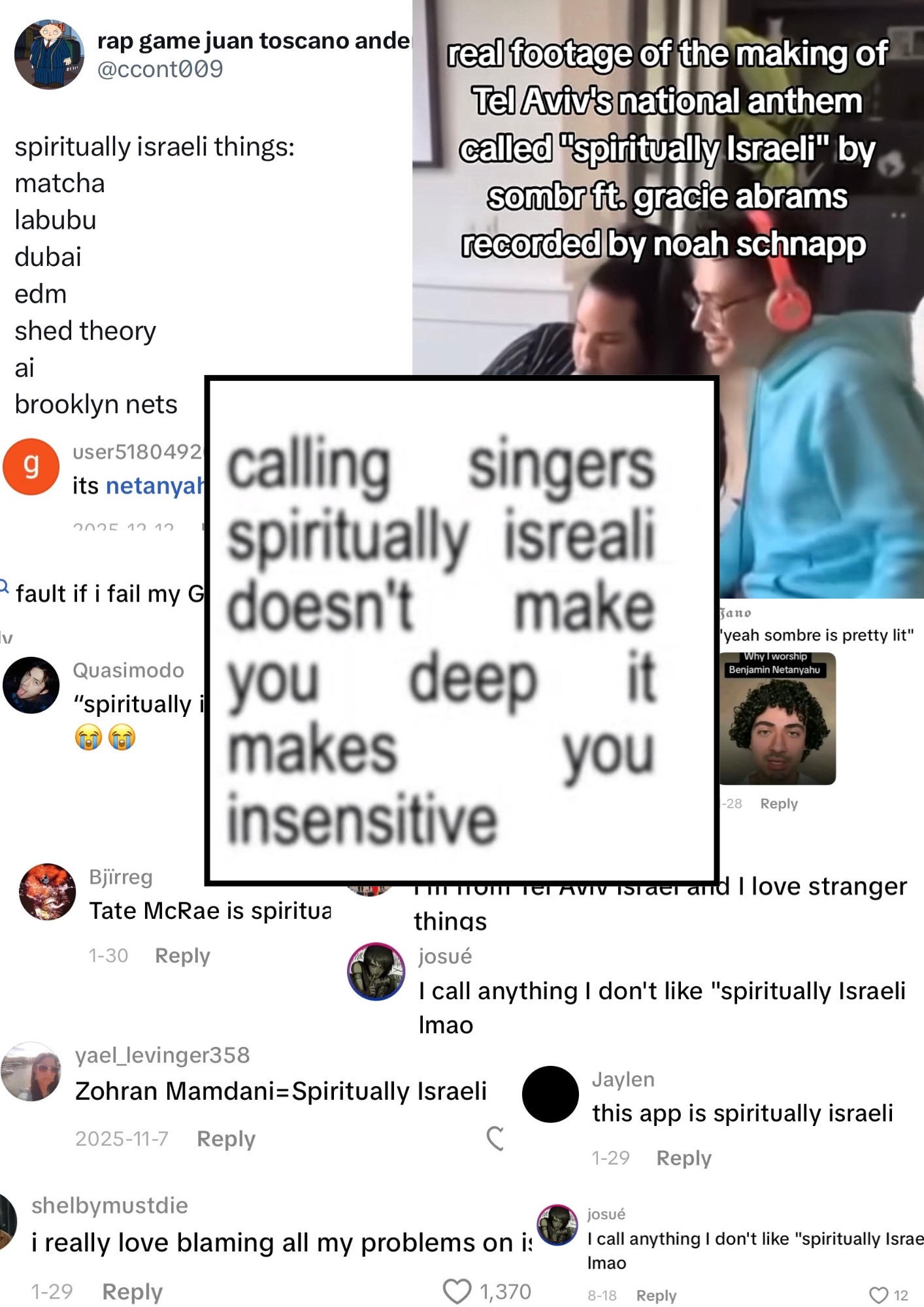
For the past couple months I have began to realise that there is a conversation we all need to desperately need to have about the way the internet uses real-world atrocities as material for pop culture discourse. Specifically, the way the language of genocide and mass violence is increasingly being repackaged as internet irony, reduced to punchlines and casually deployed to describe things as trivial as celebrity culture, overcommercialised trends and whatever happens to be considered cringe that week.
I have seen lots of phrases such as “Spiritually Israel” and “Tel and Viv” that have circulated across TikTok and other social media platforms, often as ironic shorthand for things perceived as soulless and vapid. The phrases are not necessarily making claims about Israel itself or the people who live there. Instead, they borrow the language and associations of a real geopolitical conflict to mock everything from pop stars to internet trends and sports teams. When an ongoing humanitarian catastrophe becomes a reusable metaphor for something you simply dislike, something has gone wrong with the way we communicate about political violence online.
The genocide in Gaza is not an abstract cultural reference. It is an ongoing and devastating human catastrophe involving ethnic cleansing, destruction of infrastructure and the collapse of conditions necessary for ordinary civilian life. Yet online, the language associated with this suffering increasingly finds itself detached from the people experiencing it.
There is a particular danger in this kind of humour and the fact that repetition makes the extraordinary feel ordinary. When words associated with genocide, occupation and apartheid become everyday internet vocabulary, their emotional and political weight can begin to erode. A phrase that initially shocks can eventually become just another punchline. The violence behind the reference disappears, leaving only the aesthetic of the joke. This is not suggesting that people using these phrases are consciously endorsing violence or attempting to trivialise the suffering of Palestinians, context and intentions matter, and some people may see the language as harmless and satire, or even a way to keep Israel and Palestine in the public conversation.
But intention does not erase consequence and there is a difference between using humour to expose political violence and using political violence as a convenient vocabulary for mocking something you find embarrassing.
This discourse deserves to be understood within a much broader conversation about memetic warfare.
The internet is no longer simply a space where political events are discussed after they happen. It has become an active arena in which political narratives are constructed and distorted with memes and jokes, and deliberately provocative imagery can all influence how audiences understand conflicts and the people involved in them.
The Russia-Ukraine war offers a particularly interesting example and is personally the first time I witnessed this online, research into defensive memetic warfare has examined how decentralised online movements, including the North Atlantic Fellas Organization (NAFO), have used humour and internet-native visual culture to challenge Russian propaganda and information pollution. Rather than relying exclusively on conventional political messaging, these communities have used memes to ridicule disinformation, disrupt narratives and encourage audiences to question the information they encounter.
This demonstrates that memes are not inherently trivial or politically meaningless. They can function as tools of resistance, political communication and media literacy. However, it also reveals the same mechanisms that make memes effective at challenging propaganda can also contribute to the normalisation of harmful narratives. Humour can expose power, but it can also obscure suffering. Irony can undermine authoritarian messaging, but it can also make extreme ideas feel socially acceptable through repetition and detachment.
The distinction is not simply whether something is funny or offensive. It is what the humour is doing, whose interests it serves and what it encourages an audience to stop noticing.
One of the most concerning characteristics of recent internet culture is its ability to turn almost anything into content. Political violence becomes a reaction image, atrocities become shorthand and disgusting public figures are turned into AI generated memes, detached from the harm and the crimes they caused. There is something deeply upsetting about watching a person associated with decades of child abuse and trafficking become an endlessly recycled internet character. And the issue is not that powerful or abusive people should be protected from ridicule, but the issue begins when spectacle begins to replace the substance. When someone becomes a meme, audiences gradually become more familiar with their internet persona that with the reality of their actions and the victims disappear behind the joke. It can make people feel informed and engaged while simultaneously distancing them from the human consequence of the media they are consuming, and becoming familiar with the imagery without understanding the reality is worrying, we recognise the reference without remembering the people behind it and we begin to confuse awareness with attention.
If a joke is exposing propaganda, challenging the actions of a government or drawing attention to the oppression, there is a political argument to be made for it. If genocide becomes a synonym for a pop star being cringe then what exactly is being challenged? At some point, the political reference becomes little more than an aesthetic. The real-world context is stripped away, and the suffering that gave the phrase its meaning becomes secondary to its usefulness as a punchline. That is not necessarily political awareness. Sometimes it is simply the commodification of tragedy.
The internet has given us unprecedented access to information about atrocities. We are all witnessing these events in real time, but this access we have should come with a responsibility. Because what happens when the language of mass murder becomes indistinguishable from the language of everyday online banter, what happens when the suffering of an entire population becomes a cultural reference that people can use without ever having to confront the reality behind it? There is a risk that, in trying to make everything politically relevant, we end up making nothing feel particularly serious.


