


Reflecting on the recent run of Andy Goldsworthys’ Fifty Years exhibition at the National Galleries of Scotland, the line between nature, creation and cycles has changed.
His work aims to subvert your expectations of naturist art by manipulating his subjects. Yes, plainly and simply, you could say his work contains merely leaves and sticks, but it’s the way he arranges them, contorts and even deforms his materials that will leave an inkling in your head.
While his photography may stun you, the real standouts of this exhibition are the sculptures. The use of space, comparison, and interactive elements whelms you into the surreal world of nature that Goldsworthy himself has made. Taking you room by room and element by element, he tells a story of cultures and geography. No single part of the earth’s natural resources has been neglected. Clay builds a wall; wood makes a fence, and rocks pave the floor, but never in the way you’d traditionally think.
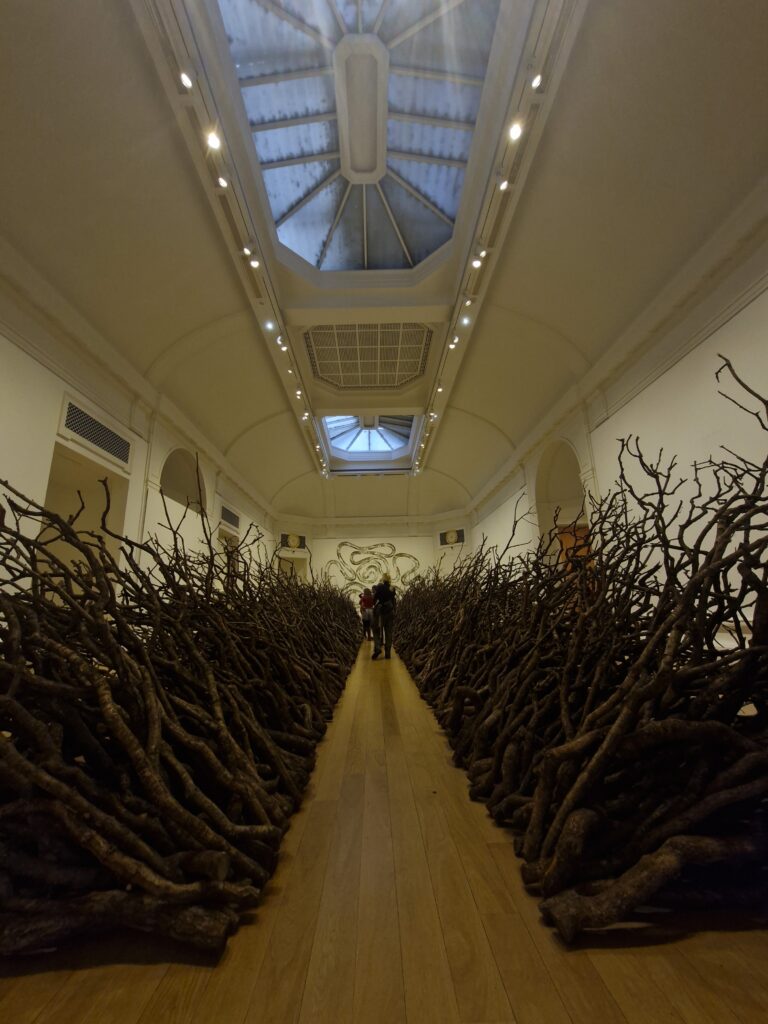
This non-traditionalism stands out most in his piece “Oak Passage”. When entering the room, the sheer scale of the passage is intimidating. The branches stretch out- sharp and dangerous, yet a clear path runs through them. The making of the piece tells a completely different story from what you first expect, the wood is collected and salvaged from fallen trees due to storms, while others are collected from trees left behind by man finished with their need for firewood. This described “Passage” is completely natural in all of its forms. The wood collected from storms tells the story of a natural cycle of weather, while firewood is also a part of the natural cycle for humans and their survival. All of it is still from nature, is still in the form of wood and is still good for practical use. Even the very wood of the gallery floor that is seen through the clear passage.

Following this idea of all inclusion, his piece “Skylight” is found secluded from the rest of the exhibition and takes up an overwhelming and excellent amount of space while framing the skylight of the room. The structure takes reed mace from various lochs in Dumfries and Galloway, capturing one of the main focal points of Goldsworthys styles, jagged and intricate texture. These reed maces are molded around the skylight and layered down from the ceiling, creating an even smaller room inside of the exhibition thereby creating a sense of solitude and exclusion. However, the maces clash against each other, forming gaps where the light of the sky can escape from. Completely under handing the feeling of exclusion. In this piece, wood touches wood, from the floorboards of the room to the beams of the ceiling. Every aspect of the room is a part of nature and included in art.

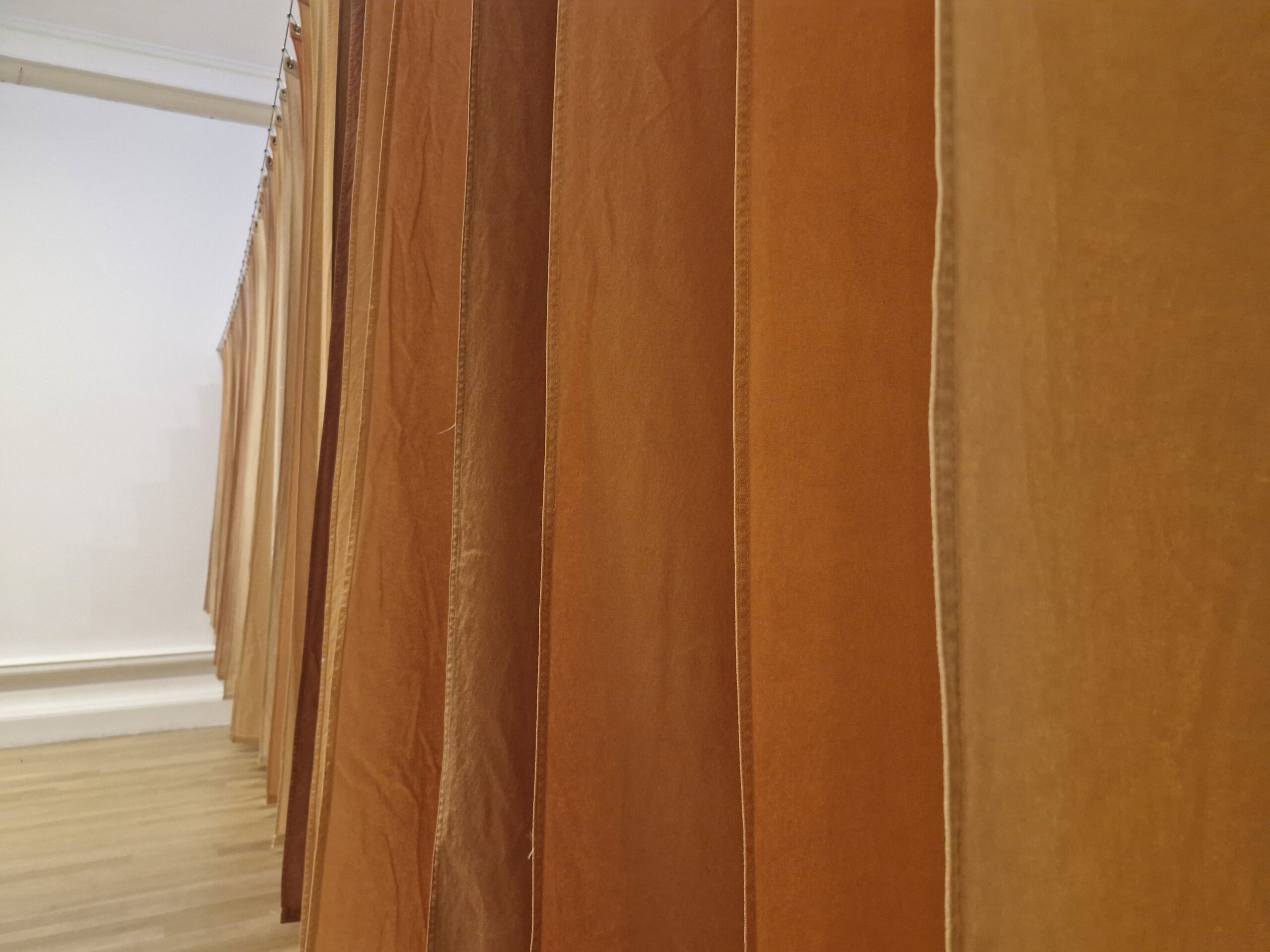
While most of Goldsworthys resources are taken from small areas of Scotland, especially Dumfries as he resides, one of the biggest and most eye-catching of his work hails from America. The piece “Flags” hangs from one end of the room to the other and coats the lighting in a warm and vibrant mixture of oranges, pinks and yellows. Fifty flags hang in varying hues of warmness to represent the reddest soil of each state. The flag, having been drenched in the literal soil of its land, holds a deep connection to each community and conjures a real connection between the meaningfulness of one’s home and the flag that represents it.

On par with the use of clay, texture and Dumfries is the “Red Wall” Created by a process of collecting, cleansing and drying clay found in the Lowther Hills the wall is a burnt sienna orange slab the size of the gallery wall, filled with cracks as the clay dries. The scale, colour and texture make the piece commanding of attention amongst an otherwise green and grey exhibition. It is exactly this colour that ties it to our most intimate relation to nature, ourselves. The iron that enriches our own blood also enriches the colour of the clay.

Another area in which you can find colour drapes the stariway to the exhibit, “Wool Runner” collects the wool from shorn colour coded sheep indicating a variety of things. Use of sheep can be seen throughout many of his pieces, including “Sheep Paintings” In which, canvases were left out in fields with a mineral block placed in the centre. Whereas many canvases were used, each canvas promised the trots of mud-covered sheep’s feet and a clean, unburdened circle of white underneath it all.
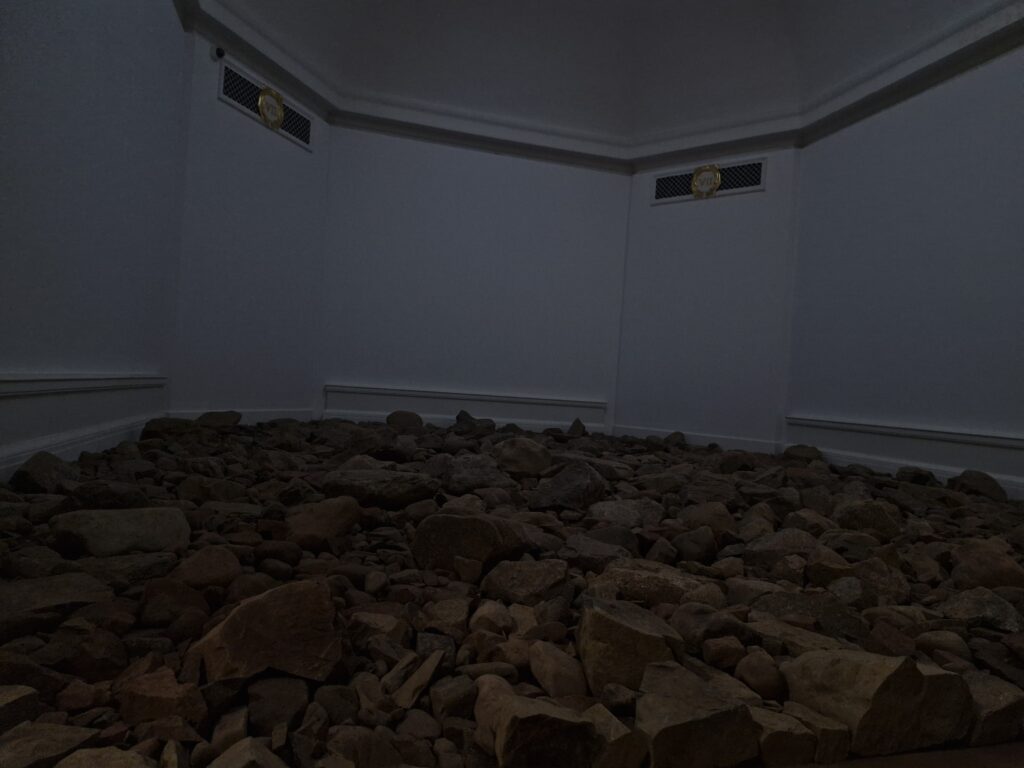
The collection of natural resources and the extent to which they are natural is a massive part of his work. The collection of gravestones left for years and found disheveled and smashed were the principal points of his work “Gravestones” titled as such. The stones filled the room, swallowed the light, and hindered the noise from onlookers. The debate as to whether these gravestones are natural or not can be argued, but at what point does something that has been a part of a scenery for years and has been made from one of the defining elements of the world, stop being natural?
On a similar note to the silence of onlookers, “Fence” acts as a tribute piece to those who have watched his work for years and allow him, with patience or lack thereof, to gather, plunder and change the surroundings of the community they occupy. The piece represents the boundaries he must maintain yet hope to amend with the way he works. Barbed wire wraps around two pillars in the gallery and blocks off one of the typical entrances. Encapsulating the limits he can achieve within his work.
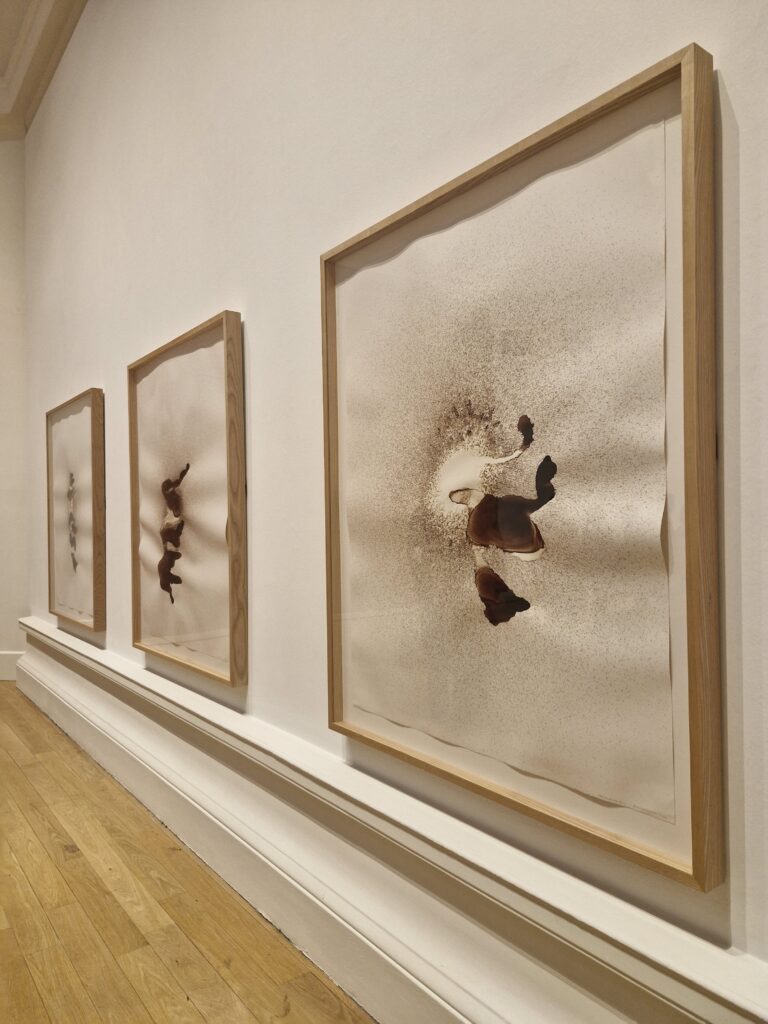
Although the sculptors were a standout. A single photography piece pierces an impression to those who learn the details. A macabre piece titled “Hare Blood Snow” is exactly as it is titled. The photographs feature an installation of three pictures, each with a pool of hares’ blood at the centre. Goldsworthy stood to test the humanity of accidentally killing an animal thus proving the cycle of life and the food chain, instead creating a fascinating depiction of an animal’s life laid bare. The methods to creating these could most definitely be contested.
Andy Goldsworthy reminds us all that the separation between what is nature and what is our home and ourselves are really no different. Everything is sourced, processed, and moulded into something new. However, how new and how separate from nature are they?


