


FC Barcelona put the region of Catalonia on the footballing map. An autonomous region of Spain, fiercely protective of its culture, language and desires for independence. Catalonia has, more often than not, been synonymous with the Blaugrana football team. FC Barcelona and Catalonia function symbiotically. Barça brings the the Catalan lifestyle, its struggles and its beauties, onto the world stage, while the regional dynamics fuel Barça with its passion, its political idiosyncrasies and its unique footballing ethos. FC Barcelona is Catalonia, and vice-versa.
“Girona became an overnight sensation: but, with celebrity, comes success and suffering in equal measure.”
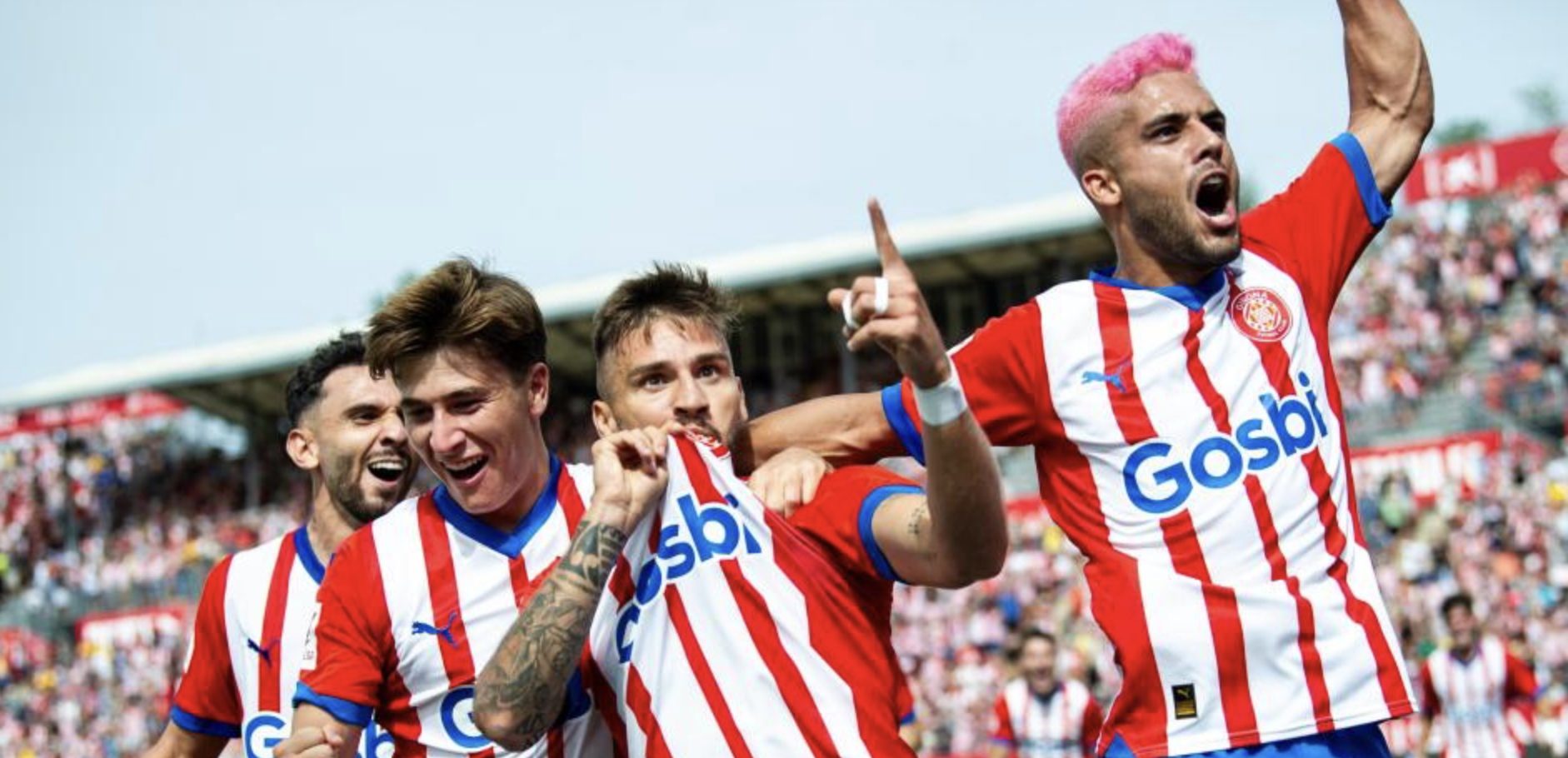
Yet, 100 kilometres to the north-east, a revolution is brewing. Footballing anarchists, tired of living in the shadows of their older, larger cousin. Nestled in the centre of the small, sleepy city of Girona, the Estadio Montilivi was the scene for the great surprise of the 2023/24 LaLiga season, if not one of the greatest shocks in LaLiga’s storied history. Girona FC utilised their status within the City Football Group (CFG) – the consortium overseeing Manchester City, alongside ‘franchise’ teams in Australia, Asia, the USA and Europe – to almost blindsiding effect, building one of the league’s strongest outfits (on a shoestring budget) thanks to CFG’s vast scouting network and resources. The football was swashbuckling. A lethal young gun-slinger in Artem Dobvyk. The metronome-incarnate in Aleix Garcia. Raw, unbounded Brazilian effervescence in Savinho. Girona were a force to be reckoned with, taking eventual title-winners Real Madrid to the wire with last-gasp winners galore, coupled with giant-slayings against Atletico de Madrid and, most shockingly, the Kings of Catalonia: FC Barcelona.

Girona became an overnight sensation: but, with celebrity, comes success and suffering in equal measure. Dobvyk, Garcia and Savinho all departed in the summer window, with mercurial wingback Yan Couto and defensive mainstay Eric Garcia following them out of the Montilivi doors. Manager Michel looked to the market to rebuild after these traumatic losses, securing the signatures of Manchester United and Tottenham Hotspur outcasts Donny van de Beek and Bryan Gil, Dutch journeyman attacker Arnaut Danjuma and, most surprisingly, Aberdeen attacking sensation Bojan Miovski. These signings – combined with keeping hold of talented stars like Paulo Gazzaniga in goal and Victor Tsigankov in the final third – seemed to suggest a side capable of maintaining their electrifying form for another season. But are Girona flattering to deceive?
The results have dive-bombed this season, displaying in clear resolution a side torn apart by the circling vultures in the summer. Since defeating Sevilla at the Estadio Ramón Sánchez Pizjuán on September 1st – Sevilla themselves enduring a torrid period of uncertainty and internal turmoil – Girona have failed to win a game. Two draws against LaLiga minnows Rayo Vallecano and Celta Vigo, combined with heavy league losses to (an admittedly high-flying) Barcelona and, astoundingly, an injury-wracked and youthful Valencia, represent a serious issue for Michel. They can be forgiven a heartbreaking 1-0 loss away to Paris Saint Germain on their Champions League debut, Girona only undone by a Gazzaniga own-goal moments before the full-time whistle: a cruel reminder of just how powerful the elite truly are.
But a 2-3 home loss to Feyenoord was intolerable, partly due to the nature of that loss. A comedy of errors, two own-goals and a missed penalty was not merely a case of three points lost: it was three points squandered. Míchel himself urged fans that there was “no need to panic”, but admitted that “it’s not worth passing the ball just for the sake of passing it”. The latter was a statement that, at its heart, perfectly summates the change in scene for Girona this season. Losing Aleix Garcia was inevitable, but a loss of that midfield quality and control is exactly the issue that allowed Feyenoord to so easily pressure and, eventually exploit, Girona’s backline for the second goal, with a loose defensive pass cut out by Quentin Timber, for a slicing through ball from Igor Paixao to set up a simple finish for Antoni Milambo. A game that Girona had begun in controlling, possessive style, quickly ran away from them: their momentum was lost after a ludicrous own goal from a set-piece, but allowing Feyenoord to so effortlessly slip into the lead a mere 10 minutes later was catastrophic. Girona’s 2023/24 style relied on ball-playing defensive players like Aleix Garcia and Eric Garcia to distribute effectively and calmly, inviting and dissipating opposition pressure. Without these talents, Girona have looked far more fallible at the back.
“With [Byran] Gil, Michel is able to play that Neo-liberal, Total-Voetbal-esque game that stunned Spanish screens last season — Gil himself something of a Cruyffian-character who distributes well, navigates the pitch in its entirety and provides pops of colour throughout a game.”
These defensive mistakes were their undoing at the Estadio Mestalla, too, for matchday 6 of LaLiga. Yes, they played a rotated team due to the close fixture proximity to their Champions League night in Paris. Yes, they faced the daunting prospect of the braying Mestalla atmosphere. Yes, they were the stronger of the two teams in the first-half, dominating the ball and harassing the Valencia backline. But two own-goals in two minutes, from the same player? It was a far-cry from the rear solidity of last season’s Catalan dark horses. Girona captain Juanpe could do little about Dani Gomez’s thundering shot from distance deflecting off of his leg for Valencia’s second, but his attempted intervention and subsequent deflection for Luis Rioja’s speculative effort from well beyond the box was reckless and, ultimately, unnecessary. Both own-goals (with the possible exception of the second), both coming from loose passes in the midfield and poor defensive initiative. Sound familiar? It certainly doesn’t when compared to last season, but it is becoming a recurring theme in this campaign.
In attack, Girona have a much more discernible identity. The addition of the aforementioned Bryan Gil is the standout signing: the only player that truly fills the gap left by Girona’s talent exodus over the summer. With Gil, Míchel is able to play that Neo-liberal, Total-Voetbal-esque game that stunned Spanish screens last season — Gil himself something of a Cruyffian-character who distributes well, navigates the pitch in its entirety and provides pops of colour throughout a game. Many tenuously attribute the Netherlands’ iconic footballing style to musical liberalism: in similar fashion, this Lennon-Starr lookalike looks set to ignite Catalonia and the continent with a bit of Beatles magic.

Gil is no one-man band, though: look at his poor goalscoring record. In this respect, Girona struggle somewhat. In the absence of Dobvyk, they’ve been relying on unusual, non-traditional goal threats, with the majority of goals coming from midfielders or, indeed, more defensive players. Club legend and cult striker Cristhian Stuani managed to notch one against Barcelona, while Abel Ruiz found another from the penalty spot. But the latter has been inconsistent, whilst the much-anticipated Danjuma has failed to impress and star-signing Miovski, whilst looking an engaging, bullish presence in the press, has been wasteful. It’s early days, certainly, but nevertheless a cause for concern for a side set up for scintillating attacks. Youthful promise in the form of youngsters Gabriel Misehouy and Yaser Asprilla offers some excitement: both have shown signs of genuine potential.
While it is highly unlikely that the side now languishing in 13th place will replicate its incredible successes from last campaign, there is still plenty to be seen from Michel’s Girona. Against big sides on even bigger occasions, the relatively-young Spanish coach has shown that his side can go toe-to-toe with anybody: a team that, on its day, can play an enviable brand of football both impressive to watch and difficult to contain. Barcelona may be the standard-bearers, but Girona will surely have more to write in the remarkable Catalan footballing catalogue.


