


Lauren Naomi, an author from New York City, currently living in Edinburgh, is expanding the realm of creative writing by publishing the novelistic memoir The Parlor Room in form of a tabloid newspaper.
I first met Lauren at the Literary Escape Festival – Edinburgh, a small get-together of indie authors and artists, seeking to promote their work outside the mass-produced consumerist bubble. She had a stand with her work on display, initially, I thought “why is she promoting newspapers, maybe she is an independent journalist”. After having a lovely chat with her, I have to admit that I was very intrigued to get a copy for myself, which I did. The experience of reading The Parlor Room was quite different than with other literary works, mainly influenced by the publishing format.
Review of The Parlor Room

The unique composition of Lauren’s work incorporates short stories about her life in the Big Apple, such as Saturday brunches with her friends, the loss of her beloved father, as well as fun and easy recipes or typical newspaper puzzles. Also worth mentioning is the script ‘A Single Rose’, which, as Lauren says, is ‘written for anyone with an idea’, encouraging the reader to engage with the script beyond the pages it was written on.
The Parlor Room consists of eleven different sections, such as ‘One Day in New York’, which follows a day in the life of two different New Yorkers or ‘A Home With Plant’, in which Lauren talks about her ever-growing plant collection, with a few tips on how to keep them alive. Because, as we all know, plants can sometimes be tricky to maintain (in my defense, those Cacti were already half dead when I bought them).
In addition to scripts and short stories, the tabloid provides the reader with little breaks in between sections. As is typical for most newspapers, brain teasers and puzzles are a constant encounter. Lauren incorporates those within her publication: ‘The Word Search: Saturday in New York’ and ‘The Crossword Puzzle’ make Lauren’s work even more interesting, as there are hardly any literary publications (that I am aware of) that include puzzles in between pages.
One of my favourite aspects of The Parlor Room is the imagery. The newspaper is full of beautiful shots of Lauren’s homely spaces, the food she and her friends prepare for their chill Saturdays together and some of New York City’s most aesthetic architecture. Out of all of these, the section titled ‘Midday Plates & Lunch Specials’ is by far my all time favourite, not only because it looks delicious, but because the recipes are easy to follow and have accessible ingredients. You will not have to go all over town to get any of those, as they are basic every day essentials most stores will provide you with. If you are craving an original New York bagel, just have a look into The Parlor Room and you will find what you need. But careful, DO NOT TOAST THE BAGEL, EVER!
Given that this unique literary approach is by an indie author and that The Parlor Room is her first publication, I would like to abstain from talking too much about the actual contents of the magazine. If you are as intrigued as I was, there will be a link provided through which you can receive your own FREE copy of Lauren’s work.
Interview with Lauren Naomi
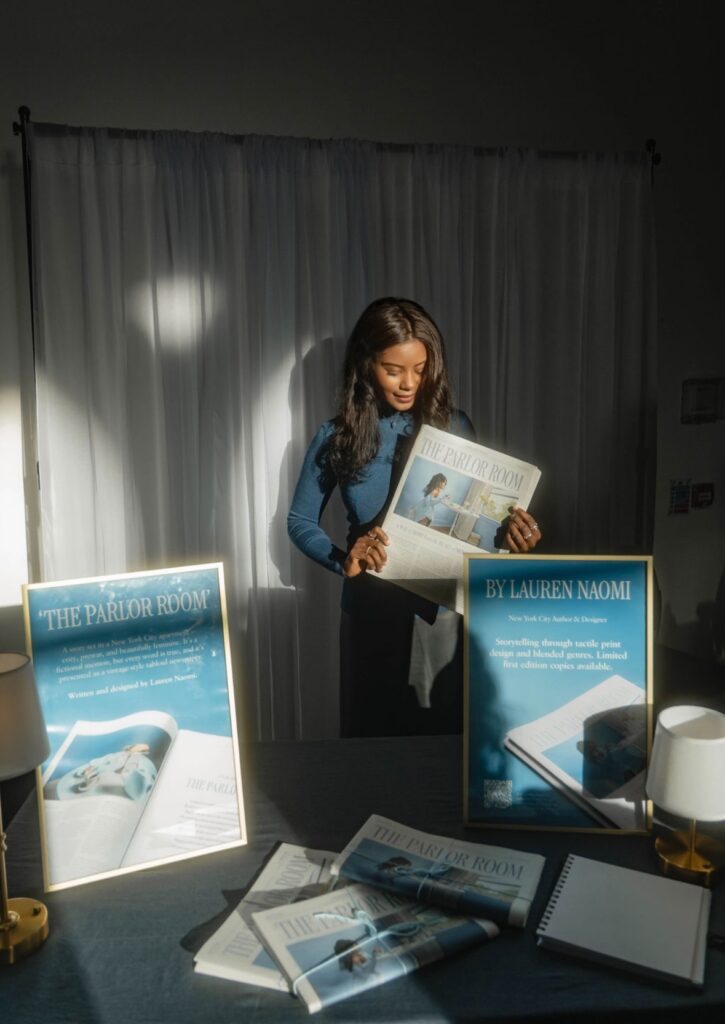
Even though Lauren has been in the creative industry for a while now, previously working as a creative director in advertising, The Parlor Room is her debut publication. As I was intrigued to hear Lauren’s own perspective about her work and why she made the stylistic format choices that contribute to The Parlor Room‘s unique appearance, I have conducted a short interview with her, in which she gives deeper insights into the process and themes of the newspaper magazine and outstanding future projects.
Andie: What inspired you to deviate from the usual paperback/hardcover book-like appearance and go for a tabloid newspaper look? Do you think that experimental presentation forms of literature could be the future of the creative industry?
Lauren: Strangely, I’ve only ever imagined The Parlor Room in newspaper form. There is a softness and mundanity to sitting with a newspaper that felt symbiotic with the themes of the work. I wanted the piece to feel lived-in and approachable, so producing it in this classic format — and layering in a New York City narrative — gave readers a comfortable entry point as the stories became more personal.
At the same time, I wanted the work to feel highly editorial and artistic, so I needed to make sure the newspaper format could support the level of photographic detail I wanted, which it ultimately did. When people first hold it, they handle it like something they’ve held before, but they also experience a bit of surprise because it’s very colorful. I really enjoy the tension between its banality as an object and its visual and design complexity.
Andie: The Parlor Room is, as you describe it, a ‘novelistic memoir’. Why was it important to you to categorize it into this specific genre, instead of, let’s say, a ‘non-fictional biography’?
Lauren: I describe The Parlor Room as a novelistic memoir because it is both a true story and a fictionalized account of my life in New York. The fictional details I wrote in aren’t embellishments of my story, but subtler choices that deepen the reader’s understanding and help them feel more immersed in the world I’m describing. I absolutely sought to tell the truth, but in my view, that truth was broader than any single factual moment. I composited and condensed real experiences and real people to make the stories readable and emotionally truthful within the limits of a short narrative form.
I did consider categorizing the work as nonfiction, but I was afraid readers might over-attach the narrative to my exact life events, when what I’m really trying to express is a broader emotional truth about home, solitude, community, and the city itself. So I’m comfortable with the novelistic memoir category because it says: I’ve honored the truth, and I’ve told it in an expansive way. For the record, The Parlor Room is almost completely factual, but only almost.
Andie: The vibe of The Parlor Room is comfy and cozy, incorporating many homely elements. Do you think that it’s important in today’s society to move away from the outside world into the setting of your own four walls?
Lauren: I think we need time out in the world, and we also need time inside our own four walls, both literally and in the deeper sense of caring for our outer and inner worlds. We’re always living in the duality of the external and the internal, and the two inform each other. In many ways, how we inhabit our homes mirrors how available we are to our own interior lives. The inner work we all have to do requires a degree of privacy that only home can give us.
At the same time, I don’t believe in isolating ourselves from the world or retreating from what is difficult or inconvenient. New York City, where The Parlor Room is set, is the greatest teacher of this because you can’t avoid anything and the world is at your doorstep. So naturally, I wouldn’t urge anyone to choose one or the other. But I do believe that home is a formative space that shapes us and the way we move through the world. Cultivating the interior life, whether in our physical spaces or within our own selfhood, helps us move through the exterior world more powerfully and more profoundly.
Andie: Some of the stories in the memoir touch on themes such as death and grief. Would you say that this was a hard subject to write and publish, given how personal and intimate it is? And why was it important for you to share such experiences with others?
Lauren: It was definitely hard and unusual to write about something so personal and publish it for others to see. Grief is deeply personal, and when you’re in it, you’re keenly aware that no one else is experiencing it in quite the same way. At the same time, you also understand that it’s a weight too heavy to carry alone without some level of understanding from others. Writing those sections felt vulnerable, but it was also a way for me to let people into my experience and invite the comfort of community.
It was important for me to share these experiences because they demonstrate just how important home can be when life falls apart. These are the moments where I discovered what it means to cultivate a space where I can grieve, process, and rebuild just as much as I live, eat, gather, and celebrate. I wanted to speak to that deeper dimension of domestic life, beyond the surface-level conversations we often have about homes in terms of aesthetics or materials.
In a time when many people are living alone or building lives that don’t look like the structures they once imagined, we have to create our own systems of support. And in the hardest moments, like when we face the death of a loved one or experience the full weight of grief, we need those systems more than ever.
Andie: Could you give any insights into upcoming projects you may be working on at the moment? Are they also going to be published in a non-conventional way, such as The Parlor Room?
Lauren: The project I’m most excited about is themed around the winter season, and I’m currently researching the scientific basis of the story and the color palette I’ll be using for it. It’s highly complex, but if I can execute it well, I think it could become something special. I’d say it’s worth staying in touch because I often invite my close community to vote on elements like cover designs and artwork, and I hope that continues as these new projects develop. Creating The Parlor Room taught me to make bold decisions and allow the work to shape itself, and I’ll definitely be carrying that same approach forward.
Final Thoughts
Overall, I would argue that Lauren Naomi’s The Parlor Room pushes the creative industry towards a new era, in which publication formats do not only serve the purpose of aesthetics, but act as storytellers themselves.
To acquire your own copy of The Parlor Room there is the possibility of either joining the waitlist on Lauren Naomi’s own website https://www.laurennaomi.com/shop/p/the-parlor-room (it’s free and signed!) or you could go and see Lauren in person at one of her next events, which will be announced on her Instagram page https://www.instagram.com/bylaurennaomi!
Finally, I would like to personally thank Lauren for taking the time to answer my questions and for sending me all the cool images provided within this article.
